
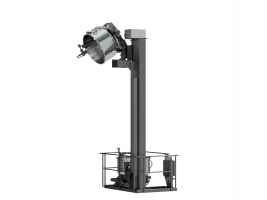
Bakery tipplers
The bakery tippler, is a device that in a modern production plant makes the difference between an efficient line and the daily physical effort of the workers. In the Bagmasz range you will find two types: bakery tipplers for bowls that work with spiral mixers and confectionery tipplers for planetary beaters. Both models have one thing in common: they do all the hard work for the operator, eliminating manual handling and tipping of containers weighing up to several hundred kilos.
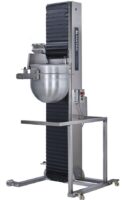
What is a bakery tippler and how does it work?
Bakery tippler, is a mechanised lifting and tilting device for bowls or cauldrons, which enables their contents to be efficiently emptied without physical effort. It consists of a base to ensure stability, a ramp for loading the container, a structural column with a geared motor and a swivel arm responsible for tilting the bowl or boiler. The entire unit is controlled from a control panel and the lifting and turning process is smooth, with no risk of uncontrolled spillage or spillage.
In the case of tipplers for bakery vats A chain mechanism lifts the bowl and tilts it over the divider hopper or the work table. On the beater boiler model (MKDKS 01), the boiler is raised and rotated at adjustable speed, allowing the cream, sponge cake or other confectionery mixture to be poured precisely into moulds or containers. The lifting speed and height can be adjusted from the control panel to suit the specific type of paste and production stage.
Bowl tippers vs confectionery tippers - which to choose?
Choosing the right model depends on which container you work with on a daily basis.
Baking tumbler for bowls is the right solution if:
- you use spiral mixers with spouting bowl,
- move heavy yeast- or bread-based doughs with a total container weight of up to 700 kg,
- you need an adjustable lifting height to match the dividing hopper or table,
- you care about optional scraper or the dough expeller module, which increase hygiene and reduce raw material losses.
Confectionery tumbler for beater kettles will work if:
- you work with planetary beaters and boilers of various capacities,
- you empty fine confectionery compounds (creams, sponge cakes, meringues), where pouring precision is crucial,
- you need electronic speed control boiler to avoid spillage.
If you are working with bowls and beaters at the same time in your plant, it is worth considering both machines as complementary parts of your production line.
Technical specifications - what do you need to know before you buy?
Before choosing a bakery or confectionery tippler, check four key parameters:
- Lifting capacity and own weight of the machine. The Bagmasz bowl tippler carries up to 700 kg (weight of the bowl with dough). The machine itself weighs 500 kg, which translates into high stability during operation. Boiler tippler for beaters (MKDKS 01) weighs 362 kg and takes 2 kW at 380V. The bowl model operates at a power 1.2 kW, making it one of the most energy-efficient appliances in its class.
- Base dimensions and available space. Bowl tippler base takes 1100×1100 mm. Before you decide to buy, plan for a minimum of 50 cm of free space on each side of the machine, because that's how much you need for the free entry of the bowl on the overrun and the exit of the operator during operation.
- Lifting height. In the bowl model, the height is individually adjusted to the customer's conditions, which means that the machine can be used with both low and high hopper dividers. Let us know the exact height of the hopper or table when ordering and we will configure the machine to suit your site.
- Construction material. The base and key supporting elements are made of stainless steel, which makes it easy to clean the unit after each production shift and meets the requirements of food environments.
How does the bakery tippler affect safety and ergonomics?
Bakery tippler eliminates one of the most common causes of injury in the bakery, the manual handling and tilting of dough containers. A bowl filled with yeast dough can weigh more than 300 kg. Even when working as a team, this is a huge strain on workers' spines and shoulders.
Bagmash equipment is equipped with:
- safety guard with microswitchwhich prevents the mechanism from activating when the operator is in the working area,
- emergency stopwhich immediately stops the machine in unforeseen situations,
- control panel with manual overridegiving full control over every stage of the process.
All models comply with CE safety standardswhich is a requirement for sanitary or PIP audits and inspections in food production facilities. One person operates the tippler independently, without the need for a second employee to hold the bowl.
Less obvious uses of the tippler in the bakery and pastry shop
Bakery and confectionery tipplers are primarily associated with emptying pans and kettles, but in practice they have a wider range of applications:
- Dosing of ingredients into process equipment – tippler for bowls is proven for the precise transfer of heavier masses into mixers or process vessels, where control over the flow of poured raw material is important. Tilting the bowl with adjustable speed avoids overloading the next machine in line.
- Support in unloading raw materials - if you get the ingredients in containers that are similar in size to the bowl (e.g. large plastic containers of fat or chocolate mix), tippler can be used to move them safely and tilt them over the boiler of the melter or mixer.
- Temporary support during servicing - during maintenance work on adjacent machines, the dumper arm is sometimes used as a support or stabilising point for a machine component when there is no auxiliary device nearby.
This is practical knowledge that you will rarely find in product brochures, but which can be just as valuable in day-to-day plant operations as the basic function of the machine.
Maintenance of a bakery tipple - what to check regularly?
Bakery tippler is a relatively simple device, but requires systematic monitoring of several key points to avoid unplanned downtime.
- Drive chain requires lubrication according to the manufacturer's schedule, usually every 200-300 operating hours. A dry chain wears out more quickly and can lead to overloading of the gearmotor.
- Guide rollers and pivot arm pin, These are the most common wear points. Visually check them weekly for play and uneven wear.
- Safety guard microswitch should be tested each time a production shift is started. If the guard does not close, the machine should not start.
- Base and overrun require daily cleaning after production. Dough residues pressed into the steel profiles are not only a hygienic problem, but also accelerate the corrosion of the welds.
- Maintenance-free bearings do not require regular lubrication, but it is worth checking them acoustically every month. A change in operating tone (squeaking, scrubbing) signals the need for replacement.
In the event of a breakdown, do not attempt to repair the lifting mechanism yourself. Bagmasz offers a technical service for bakery and confectionery machinery throughout the country.
How to integrate a tippler into an existing production line?
- Bakery tippler only achieves its full effectiveness if it is properly integrated into the production line layout. Some principles to consider when installing:
- Position the tippler as close as possible to the spiral mixerto reduce the distance the worker travels with a full bowl. The optimum layout is: mixer > tippler > single-axis divider or work table with minimal torsion of the bowl path.
- Ensure the right surface. The floor in the tipping area should be even, non-slip and without thresholds. Even minor unevenness when rolling a full bowl can cause uncontrolled movement of the bowl and danger to the operator.
- Leave the operator's exit sector free. The working zone of the dumper is at least 1.5 m×1.5 m in front of the overrun entrance. Do not place fixed equipment in this zone.
- Coordinate the working rhythm with the oven and the growth chamber. Tippler is best used when you deliver the dough in regular batches. Integration with proliferation chamber i rotary kiln in a single production cycle reduces the time from mixing to baking and eliminates dough buffering on the tables.
If you are planning to build or modernise a line from scratch, Bagmasz's consultants will help design the layout of the machinery including the tippler, spiral mixers i bakery equipment.
5 mistakes when choosing a bakery tipple that cost dearly
Mistake 1: You buy a tippler without checking the height of the divider hopper. If the lift height does not fit your divider, the dough will spill past the hopper. Always give us the exact dimension when ordering.
Mistake 2: You choose a model with too small a load capacity. A 200-litre mixer bowl filled with yeast dough can weigh 250-300 kg, and the bowl itself another 80-100 kg. Count the total, not just the weight of the dough.
Mistake 3: You are ignoring the dimensions of the base in relation to the available space. The 1100×1100 mm base means plenty of space in a cramped bakery. Measure the installation area before you place your order.
Mistake 4: You are treating the bowl tipper as a replacement for the boiler tipper. These are two different devices for different containers and different masses. Tippler
for children is no substitute for a model for the beaters in the confectionery.
Mistake 5: You overlook service planning and parts availability. The tippler works intensively, even dozens of cycles per day. Choose a supplier that offers service and spare parts nationally.
FAQ - Frequently asked questions about bakery tipplers
Does the bakery tippler require a special power supply?
Bowl tumbler The Bagmash operates at 1.2 kW and standard three-phase power. The beater boiler model (MKDKS 01) draws 2 kW at 380V. In both cases, a three-phase power supply is required, which is standard in professional bakeries and confectioneries.
How long does it take to install a tipple in a bakery?
Assembly bakery tipplers is usually a matter of one working day, assuming that the work site is prepared in advance (proper surface, electrical connection). Bagmash offers delivery with installation and operator training.
Can the tippler be adapted to a non-standard height of the dividing hopper?
Yes. The lifting height of the bowl model is individually configured to the customer's requirements. When placing an order, it is sufficient to specify the height of the hopper or the top on which the tippler is to empty the bowl.
Do you have questions about model selection for your plant? Contact us on +48 43 824 33 00 or write to bagmasz@bagmasz.com. We can advise you free of charge and help you select a bakery or confectionery tippler to suit your production line.


